
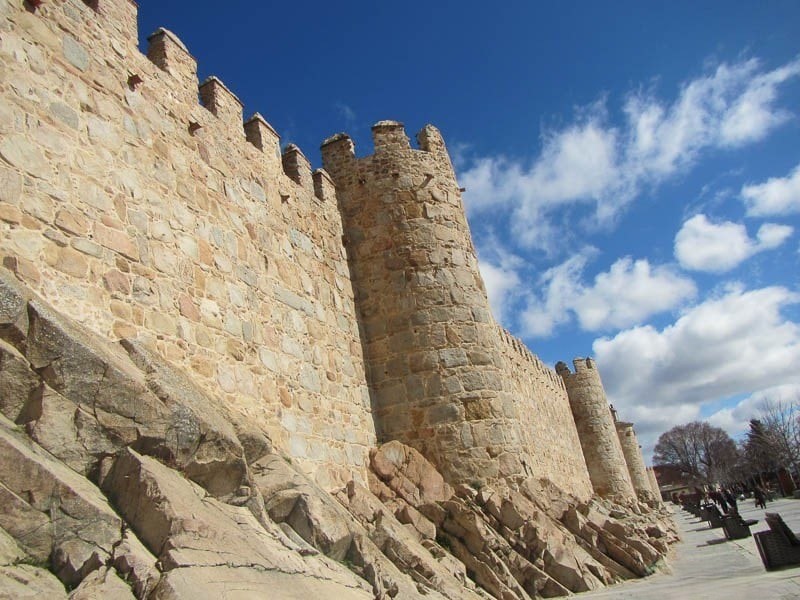
Is the walk worth braving the cold? Yes. But only if you’re dressed for it.
Avila sits at 1,131 meters above sea level — higher than the base of most ski resorts in the Pyrenees. The sun can be blinding at noon in any month. The wind on the exposed walkway at 8 a.m. will make your ears ache within minutes. This is not a casual urban promenade. The walls are genuinely cold for most of the year, and the intense midday sun adds a UV component that catches visitors completely off guard.
The walls themselves are roughly 2,500 years old in origin — built up by Romans, extended by Visigoths, and rebuilt to their current form by Castilian kings in the 11th and 12th centuries. They run 2.5 km around the medieval city, average 12 meters high, and include 88 towers and 9 gates. UNESCO listed them in 1985. You walk the same medieval patrol route soldiers used — same height, same views across the high Castilian plateau, minus the threat of cavalry.
Here’s everything you need to actually plan this walk.
Tickets, Access Points, and How Long This Actually Takes
The walls are not free. There are two main circuits, each with its own entry gate and separate ticket. Most visitors walk one — usually the north circuit, which is the more dramatic of the two. Doing both in a single day is easy and worth it if you have the time.
| Section | Entry Gate | Adult Price | Length | Walking Time |
|---|---|---|---|---|
| North Circuit | Puerta del Alcázar | ~€5 | 1.3 km | 45–60 min |
| South Circuit | Puerta de San Vicente | ~€5 | 1.2 km | 40–55 min |
| Combined Pass | Either gate | ~€7 | ~2.5 km | 1.5–2 hrs |
| Under 8 years | Either gate | Free | Either section | — |
Prices shift slightly year to year — confirm at the gate on arrival. The ticket booth opens at 10 a.m. from November through March, 9 a.m. the rest of the year. No advance online booking for individuals. Cash and card both accepted.
When to Go for the Best Light
The north circuit faces the Sierra de Gredos mountain range to the south and west. Late afternoon in spring delivers angled golden light across the old limestone — the kind photographers wait hours to catch in other places. In winter, the sweet spot is 11 a.m. to 2 p.m. The sun is low, the shadows long, and every battlement looks deliberately architectural against the pale sky.
Avoid midday in July and August. The stone bakes and radiates heat upward. The walkway is fully exposed with zero shade and nowhere to stop. You’ll spend more time squinting than looking. The €7 combined pass in April or early October is one of the best-value half-days in all of Castile — don’t overthink it.
Getting There from Madrid
Avila is 113 km west of Madrid. The RENFE regional train from Chamartín station takes about 90 minutes and costs €7–12 depending on the service and how far in advance you book. The station sits on the south side of the city — a flat 10-minute walk to the south wall. No rental car needed; everything worth seeing is walkable from the station.
The train drops you at the south side. Turn left (east) for Puerta de San Vicente, right and uphill (west) for Puerta del Alcázar. Both are under 15 minutes on foot from the platform.
The Cold at 1,131 Meters Is Not a Minor Detail
Most travel pieces about Avila mention the altitude and move on. That’s a mistake. The altitude isn’t scenery — it’s a physical condition that shapes every minute on the exposed walkway.
Avila records over 25 frost days per year. The city sits on the high Castilian plateau with no terrain to break the northwest wind. The walls rise above the city roofline, fully exposed on all sides. On a clear February morning, the base of the wall might read 4°C. Add wind on the exposed northwest stretch and the apparent temperature drops to -2°C or below. The sun can be brilliant at the same time. Cold air and bright sun simultaneously — that’s the Avila wall experience from October through April. Both conditions are real. Plan for both.
The Three-Layer System That Works
Two layers are not enough on the exposed sections. You need three.
Base layer: The Uniqlo Heattech Ultra Warm Long-Sleeve T-Shirt (~$20) is the most cost-effective choice by a wide margin. Thin, genuinely warm, and cheap enough to pack for a single day trip. For natural fibers, the Icebreaker Merino 200 Oasis Crewe ($100) handles temperature changes significantly better — when you step off the wall into a heated café or the cathedral interior, synthetic base layers turn clammy fast. Merino doesn’t. Worth the price difference if you’re doing multiple indoor-outdoor stops in one day.
Mid layer: Packable insulation. The Patagonia Nano Puff ($199) is the standard recommendation — it compresses to the size of a water bottle, blocks wind effectively, and doesn’t create bulk in the narrow wall passages. The Columbia Powder Pass Hooded Jacket ($120) is a solid budget alternative with comparable warmth on days without significant gusting.
Outer layer: From October through April, add a wind shell over everything. Gusts on the exposed northwest section regularly exceed 30 km/h. A Decathlon Forclaz trekking anorak (~€35) stops the wind cleanly and packs into its own pocket. You don’t need technical mountaineering gear — just something that blocks moving air.
Don’t skip gloves. Stone at altitude draws heat directly from your hands. The battlements are tactile and irresistible; you will touch everything. Keep your hands warm enough to stay engaged with the walk.
Cold Air Does Not Mean Low UV
UV intensity at 1,131m runs roughly 30% higher than at sea level. Pale limestone reflects additional light upward. You’re receiving UV from above and from the wall surface at the same time.
Wear sunglasses — any polarized lens with a UV400 rating protects adequately. Oakley Sutro ($189) covers well against side exposure on open stretches; Ray-Ban Wayfarer ($200) handles direct overhead sun without color distortion. A cheap UV400 pair from Decathlon works fine if brand isn’t a factor for you.
Bring La Roche-Posay Anthelios SPF50+ regardless of the month. Visitors who burned badly on February visits all said the same thing afterward: it was cold, so they didn’t think about sunscreen. Cold air does not reduce UV radiation. Apply before you start the walk, not after your nose starts to sting. If you have only sunglasses and no sunscreen, put whatever you have on your nose and the tops of your ears first — those burn fastest on an exposed wall walk.
Five Specific Spots That Justify the Ticket
The circuit covers 2.5 km, but not all of it delivers equally. These are the five places worth slowing down for — and why each one is worth your time specifically.
- Alcázar Tower Section (northeast corner) — The highest walkable point on the north circuit. On a clear day, the snowcapped Sierra de Gredos range is visible to the southwest, sitting above the plateau like a different world. Morning sun hits the outer wall face at full angle here before it does anywhere else on the circuit. Go here first while the light is still low and directional — this is the most photogenic stretch of the north walk, and the one most visitors rush through on the way somewhere else.
- Cathedral Apse Section (east wall) — Avila’s cathedral is physically integrated into the defensive wall. The apse protrudes outward from the eastern face, built directly into the fortification. It is the only cathedral in Spain that served simultaneously as a military defensive structure, and from wall level you can see exactly how medieval builders merged religious architecture with battlements. There is nothing comparable anywhere else in the country. Stop here, look at the junction point between the apse and the original wall, and take a moment to understand what you’re looking at.
- Above Puerta del Alcázar (southeast gate) — Stand on the inner walkway directly above the main gate arch between noon and 2 p.m. The sun backlights the outer façade cleanly, and the gate arch frames the road leading south from the city. Best photography position on the entire circuit by a clear margin. If you only have time for one stop on the full walk, make it here at midday.
- Northwest Stretch (between towers 38 and 42) — The quietest section on the full perimeter. Group tours from Madrid rarely reach this far. Views over the old Jewish quarter and down into the river valley are wide and unobstructed, with nothing modern visible in the sightline. In shoulder season, you may have this stretch entirely to yourself for 15 minutes at a stretch — a rarity on any UNESCO site in Spain.
- Los Cuatro Postes (off-wall viewpoint, 500m northwest) — Not part of the ticketed circuit. A free-standing viewpoint about 500m northwest of Puerta del Puente, consisting of four stone posts that frame a complete view of the walled city perimeter with the cathedral visible at center. This is the image most people associate with Avila — the one on every postcard. The walk from Puerta del Puente takes 10 minutes. Go at golden hour. It reframes everything you just walked from the inside.
Bring water. Dry high-altitude air and direct sun dehydrate you faster than they would at lower elevation, even when it’s cold. No water points exist on the wall itself — fill a bottle before you start.
Mistakes That Cut the Walk Short
Does walking direction change the experience?
For photography on the north circuit, it changes it significantly. Walking east to west — counterclockwise, starting at Puerta del Alcázar — keeps the morning sun behind you the whole way. Shots are front-lit, stone color accurate, shadows falling away from your lens. Walking west to east means shooting directly into the sun until early afternoon, and the glare off pale limestone is punishing. Start at Puerta del Alcázar and walk counterclockwise. Light works for you the entire way, not against you.
Is Los Cuatro Postes included in the wall ticket?
No — this is the most common point of confusion for first-time visitors. Los Cuatro Postes is an entirely separate viewpoint outside the city walls, about 500m northwest of Puerta del Puente. It’s free and accessible on foot in 10 minutes from the gate. The wall ticket covers nothing outside the perimeter. Go after finishing the wall circuit. Seeing the entire perimeter from the outside — especially in late afternoon light — puts everything you walked into full context. Don’t skip it because you assumed it was included.
Should you pay for the south circuit?
For most visitors: no. The south circuit runs lower and looks over the modern expansion of the city rather than the medieval quarter. Views are less dramatic, the section is less photographed, and the experience is noticeably flatter than the north. If time is limited, the north circuit plus Los Cuatro Postes delivers the best 80% of the Avila experience for €5 rather than €7. The combined pass makes sense only if you want the complete historical perimeter or you have a full day in the city with nothing else on the schedule.
What about going on a cold, sunny winter day?
Those are actually among the best days to visit. Winter days in Avila are often crystal clear — cold air from the northwest scrubs the atmosphere clean, and the Sierra de Gredos snowcaps are sharp on the horizon in a way summer haze never allows. The mistake is treating brilliant sunshine as evidence of warmth. At 1,131m in January, 12°C in direct sun feels like 3°C on the exposed wall with wind. Visitors in light jackets last 20 minutes before retreating to a café. Visitors in a proper three-layer setup stay for two hours and leave with the best photographs they’ll take in Spain.
The Verdict
The north circuit at €5 is one of the best-value travel experiences Spain offers. Do it in spring or autumn, start at Puerta del Alcázar before 10 a.m., and wear a real base layer — the Uniqlo Heattech Ultra Warm or the Icebreaker Merino 200 Oasis Crewe, not just a hoodie.
The wall doesn’t forgive underpreparation. Come ready, and it delivers completely.